The easiest SK hynix story is that AI needs more memory, SK hynix leads HBM, and the new SKHY listing gives U.S. investors direct access. Every part of that sentence is directionally useful. None of it is enough to value a cyclical semiconductor manufacturer.
A more durable thesis starts with the supply chain. It asks where capacity is genuinely scarce, how long qualification takes, what customers can substitute, and what evidence would show that the bottleneck is easing. That framework makes SK hynix more interesting—but also less comfortable—than a simple AI slogan.
DRAM Is Still the Economic Core
SK hynix is often discussed as an HBM company, but HBM is a premium form of DRAM rather than a separate economic universe. The amended SEC prospectus shows DRAM generated 77.1% of revenue in 2025 and 77.3% in the first quarter of 2026. HBM changes the product mix, selling price, manufacturing complexity, and customer relationship, yet the company remains deeply exposed to memory-industry supply and demand.
The 2025 financial results were exceptional: SK hynix reported KRW 97.1467 trillion in revenue and KRW 47.2063 trillion in operating profit. The company said HBM revenue more than doubled year over year. Those numbers demonstrate operating leverage when pricing, mix, and demand align. They also create a difficult comparison base. Investors buying after record results need to decide how much of that profitability is structural and how much belongs to a powerful part of the cycle.
Why HBM Is a Real Chokepoint
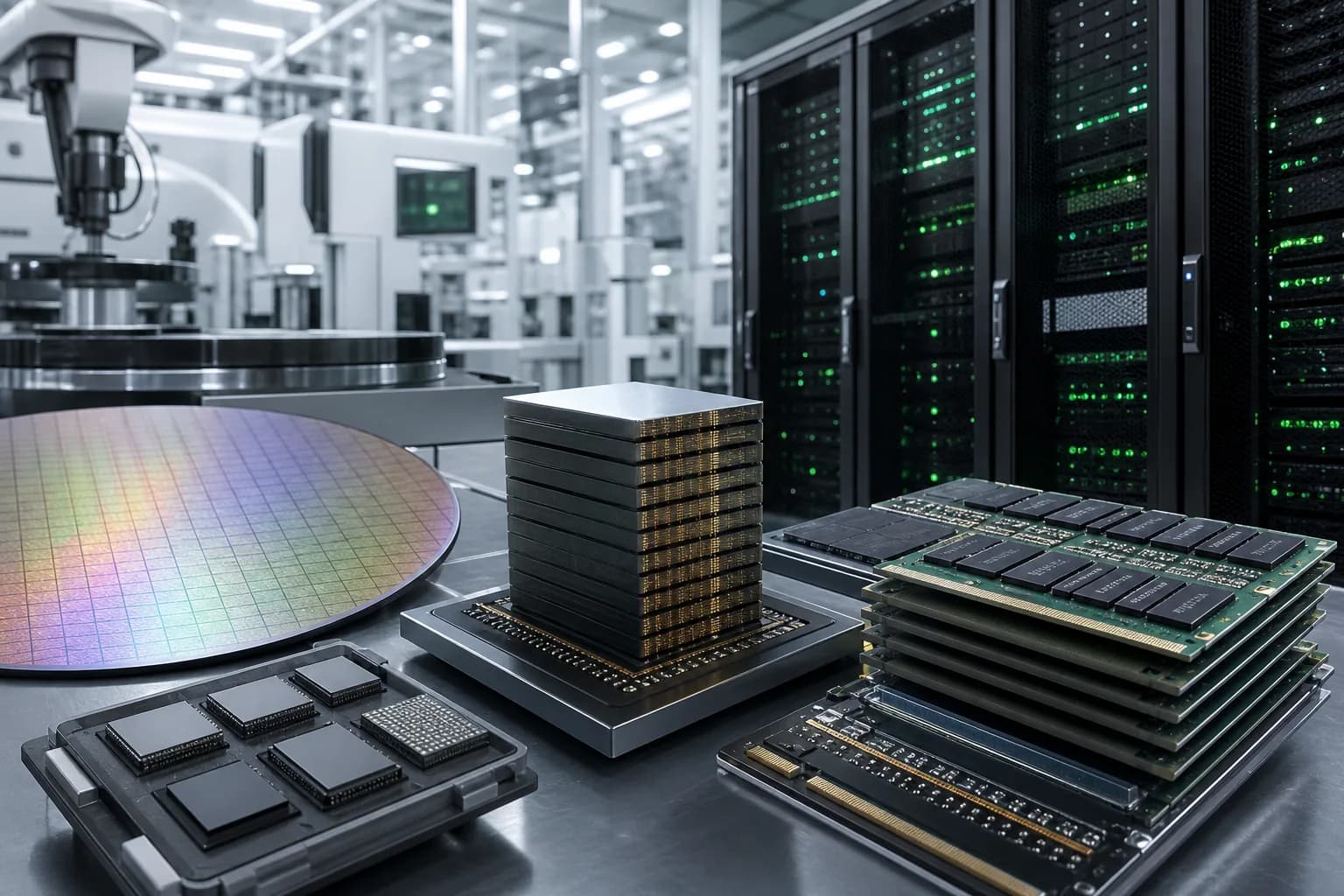
AI accelerators can perform enormous numbers of calculations, but they need data delivered fast enough to keep those compute units busy. HBM addresses that bottleneck by stacking DRAM dies and connecting them through high-density vertical interconnects near the processor. The finished package offers much higher bandwidth than conventional memory placed farther away on a board.
The supply-chain sequence looks roughly like this:
- Cloud and model developers commit capital to AI training and inference.
- Accelerator designers and system companies specify compute platforms.
- HBM suppliers manufacture advanced DRAM dies and stack them into memory packages.
- Packaging partners integrate memory and logic while controlling heat, signal integrity, and yield.
- Customers qualify the complete solution before volume deployment.
The constraint is not just wafer starts. It also includes leading-edge DRAM processes, through-silicon-via execution, stacking equipment, packaging capacity, yields, and customer qualification. Adding nominal capacity does not immediately create customer-approved HBM output. This is one reason the market can remain tight even while companies announce large capital budgets.
In its SEC filing, SK hynix cited IDC data showing a 56.4% share of global HBM revenue in the first quarter of 2026. That leadership matters because customers do not casually switch a critical memory package after platform qualification. But market share is evidence of present strength, not a permanent right. Competitors can improve products, yields, and capacity, while customers have strong incentives to qualify additional sources.
The Bull Case in Four Parts
1. AI Moves From Training to Broad Inference
Training large models created the first HBM demand wave. Inference can broaden the installed base across cloud services, enterprise systems, and specialized applications. If inference architectures continue to demand large memory capacity and bandwidth, AI memory growth can outlast a single accelerator generation.
2. Product Mix Can Stay Better Than Old DRAM Cycles
HBM and high-capacity server DRAM are more technically demanding than commodity PC memory. Qualification, customization, and packaging create stickier customer relationships. A sustained shift toward these products could support higher margins than investors associate with older memory cycles.
3. HBM4 and Custom Memory Deepen Collaboration
SK hynix says it entered large-scale HBM4 production after preparing mass production in 2025. The company is also emphasizing custom HBM. If memory design becomes more closely tied to each accelerator platform, the supplier relationship can move upstream from component procurement toward co-development.
4. Capital Spending Can Reinforce Scale
The company has outlined major expansion across Yongin, Cheongju, and advanced packaging. Scale can improve customer confidence and spread research spending across more output. If demand remains ahead of qualified supply, those investments can convert a technology lead into durable revenue.
Build the Bear Case Before the Bull Case
DRAM Pricing Can Reverse Faster Than Narratives
Memory remains one of the clearest examples of semiconductor operating leverage. A small change in supply-demand balance can produce a large change in average selling prices and profit. HBM may be tight while conventional DRAM or NAND weakens. A blended company result can deteriorate even if the headline AI product remains healthy.
Capacity Is a Solution and a Future Risk
Every supplier wants to capture AI-memory economics. The industry is committing huge sums to fabs, equipment, and packaging. Today, slow qualification and long construction schedules protect pricing. Later, the same projects could create oversupply if AI demand disappoints, customers optimize memory use, or competing suppliers ramp successfully.
Customer Concentration Cuts Both Ways
A small group of accelerator and cloud customers can account for a large share of advanced-memory demand. Deep relationships support visibility, but they also give buyers negotiating power. A delayed platform, qualification problem, architecture change, or decision to dual-source can move revenue sharply.
Execution Risk Rises With the Stack
HBM demands good DRAM dies, reliable interconnects, precise stacking, thermal control, packaging, and final system qualification. A yield problem at any stage can reduce sellable output. The more advanced the stack, the more expensive a mistake becomes.
Geopolitics Is an Operating Variable
SK hynix operates fabs in South Korea and China, sells into a global customer base, and relies on advanced equipment and materials. Export controls, tariffs, licensing decisions, and U.S.-China tensions can affect equipment access, product shipment, and capital allocation. This is not a remote disclosure item; it belongs in the earnings model.
Valuation Can Be Right About the Business and Wrong About the Stock
A company can execute well while its stock underperforms because expectations were even higher. The SKHY listing may attract investors who previously could not buy the Korean shares, but it can also invite a direct valuation comparison with Micron and U.S. AI stocks. The correct question is not whether SK hynix is strategically important. It is what level of future pricing, volume, margin, and market share is already embedded in the security.
What Would Break the Thesis?
A good investment framework names its disconfirming evidence in advance. For SK hynix, the thesis would weaken materially if several of these appeared together:
- HBM revenue growth slows while announced industry capacity accelerates.
- Customer qualification losses reduce next-generation HBM market share.
- Conventional DRAM contract prices decline despite strong bit shipments.
- Capital spending rises faster than operating cash flow for several quarters.
- Inventory grows faster than revenue across SK hynix and its major customers.
- Gross or operating margins compress before new fabs begin contributing meaningful volume.
- Export controls materially restrict equipment upgrades or customer access.
A Better Quarterly Dashboard
| Metric | Why it matters | Warning sign |
|---|---|---|
| DRAM and HBM revenue mix | Shows whether premium AI memory is lifting the portfolio | HBM growth slows while conventional products carry more of the result |
| Average selling prices | Memory earnings are highly sensitive to price | Price declines outpace manufacturing cost reductions |
| Bit shipments and inventory | Separates healthy demand from channel stocking | Shipments grow but customer or supplier inventory rises faster |
| Capex and free cash flow | Tests whether expansion is self-funded | Capex rises while cash conversion deteriorates |
| Qualification and yield | Determines sellable HBM volume | Product announcements arrive without volume or customer evidence |
| Conventional DRAM and NAND | These businesses still influence total profit | Weak commodity pricing overwhelms HBM strength |
Direct SKHY Exposure Versus Semiconductor ETFs
SKHY offers concentrated exposure to one memory manufacturer. A semiconductor ETF spreads risk across chip designers, foundries, equipment makers, analog companies, and sometimes memory suppliers. That diversification reduces company-specific risk but also dilutes a pure HBM thesis.
Do not assume an ETF owns SKHY because its name includes “semiconductor” or “AI.” Index country rules, listing history, liquidity screens, rebalancing schedules, and position limits differ. Holdings can change after the Nasdaq listing, so verify the latest fund file. Leveraged single-stock ETFs are a separate category: daily resetting can produce returns that differ sharply from twice the long-term move of SKHY.
Bottom Line
SK hynix sits at a genuine AI infrastructure chokepoint. The evidence includes HBM market leadership, record financial results, a high DRAM revenue mix, and customer demand for increasingly complex memory. The risk is that investors confuse a real bottleneck with a permanent shortage. Memory capacity eventually responds, customers qualify alternatives, and prices remain cyclical.
The strongest way to research SKHY is to track both stories at once: the structural rise of bandwidth-intensive computing and the old discipline of memory-cycle analysis. If one side is missing, the thesis is incomplete. For a broader introduction, see the ETFSift DRAM guide and use the ETF comparison tool to review diversified semiconductor exposure.
Primary Sources and Further Reading
- Nasdaq Trader Alert: SK hynix listing and symbol timetable
- SK hynix amended Form F-1 filed with the SEC
- Form F-6 for the SK hynix American depositary shares
- SK hynix FY2025 financial results
- SK hynix mid-to-long-term manufacturing investment strategy
Information is current as of July 10, 2026. Market terms, prices, exchange rates, ETF holdings, and trading arrangements can change. This article is for research and education, not personalized investment advice.